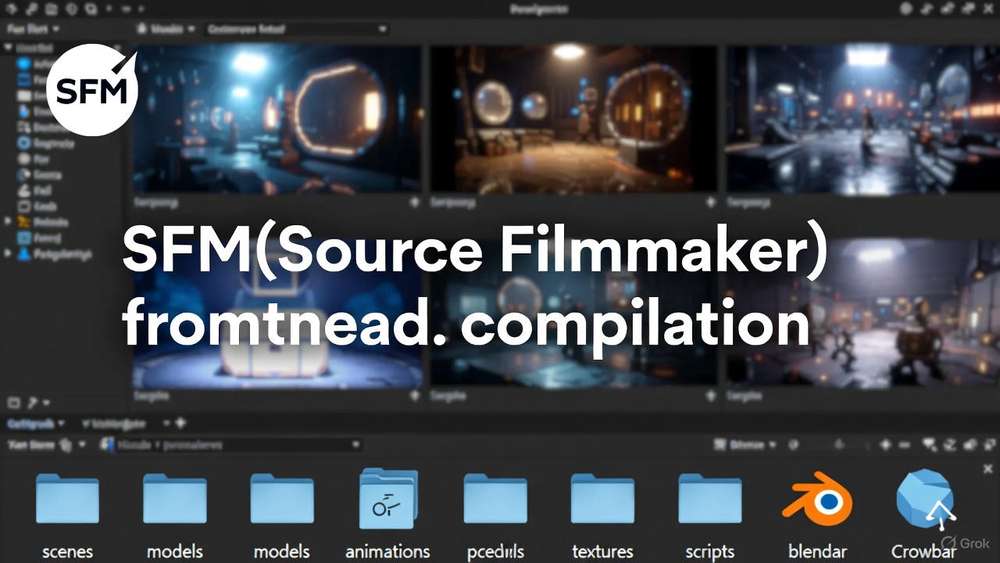
sfm compile
Imagine crafting a stunning animation where characters from your favorite games leap off the screen in a cinematic masterpiece. That’s the magic of Source Filmmaker (SFM), Valve’s free tool that turns static game assets into dynamic stories. But before your vision hits the render button, there’s a crucial step: SFM compile. This process transforms raw 3D models, textures, and animations into formats the Source Engine can handle seamlessly.
For beginners, SFM compile might feel like decoding an ancient script—intimidating yet rewarding. Whether you’re porting a custom character from Blender or tweaking a map for a dramatic scene, compiling ensures everything loads without glitches. Released in 2012 alongside Team Fortress 2 promotions, SFM has evolved into a staple for machinima creators, modders, and indie filmmakers. Today, with communities buzzing on platforms like Steam and Reddit, it’s easier than ever to dive in.
In this guide, we’ll break down what SFM compile means, walk through practical steps, troubleshoot headaches, and share tips to elevate your workflow. By the end, you’ll confidently compile assets that shine. Let’s turn your ideas into reality—one compiled file at a time.
What Is SFM Compile?
At its core, SFM is the bridge between creative chaos and polished output in Source Filmmaker. It refers to converting editable assets—like 3D models exported from Blender, image files for textures, or skeletal animations—into engine-ready formats such as .MDL for models or .VTF for textures. Without this step, SFM can’t interpret your work, leading to invisible characters or crash-prone scenes.
Why does it matter? The Source Engine, powering games like Half-Life 2 and Counter-Strike, demands optimized files for real-time rendering. Compiling packs in physics data, collision meshes, and material shaders, ensuring smooth performance even in complex scenes. For instance, a raw .OBJ model from a 3D sculpting session won’t load; compiling it via a .QC script creates a .MDL file that SFM recognizes instantly.
Historically, SFM compile grew from Valve’s need to create in-game cinematics. Early users tinkered with Studiomdl.exe, the command-line compiler bundled with the Source SDK. Over time, tools like Crowbar simplified it, making it accessible to hobbyists. Today, it’s not just technical—it’s artistic empowerment. A well-compiled asset can cut render times by 30% and eliminate frustrating errors, letting you focus on storytelling.
Think of it like baking a cake: Raw ingredients (assets) need mixing and oven time (compilation) to become shareable delight. In the next sections, we’ll explore the types of compilation and the tools that make it painless.
Why SFM Compile Matters for Animators
Diving deeper, it isn’t a chore—it’s the foundation of professional-grade animations. Poor compilation leads to artifacts like flickering textures or unresponsive rigs, derailing your project. Conversely, mastering it unlocks endless customization: Import a sci-fi hero from free model libraries, compile it with custom skins, and animate epic battles in minutes.
For SEO-savvy creators searching “how to compile custom models in SFM,” the payoff is huge. Compiled assets integrate flawlessly, boosting frame rates and export quality. In collaborative workflows, like fan films or YouTube series, shared compiled files ensure consistency across teams. Plus, with SFM’s open ecosystem, compiled mods from communities like SFM Compile Club extend to other Source games, amplifying your reach.
Data from Steam Workshop shows over 1 million SFM assets downloaded monthly, many requiring compilation. Neglect it, and your animation risks rejection in tutorials or collabs. Embrace it, and you join creators who’ve amassed millions of views. Now, let’s gear up with the right tools.
Essential Tools for SFM Compile
No SFM workflow is complete without the right kit. Start with the basics, then layer on advanced options as you grow.
Core Compilers and Editors
- Studiomdl.exe: The OG command-line tool in SFM’s bin folder. Ideal for batch compiling multiple models via scripts.
- Crowbar: A user-friendly decompiler/compiler GUI. Drag-and-drop .QC files for quick .MDL outputs—perfect for beginners, querying “SFM compile tool easy.”
Asset Preparation Software
- Blender with Source Tools: Free 3D modeler with plugins for exporting .SMD/.DMX files. Rig your character here before compiling.
- VTFEdit: Converts images to .VTF textures and generates .VMT materials. Handles bump maps and alphas effortlessly.
Map and Advanced Helpers
- Hammer Editor: SFM’s built-in level designer for compiling .VMF maps to .BSP.
- GUIStudioMDL: A graphical frontend for Studiomdl, with previews to catch errors early.
Install via Steam: Launch SFM, access Tools > Source SDK Base 2013 Singleplayer. Download Crowbar from its Steam group for extras like batch processing. These tools form a lean setup—under 500MB total—yet power pro-level results. Pro tip: Always verify file paths match your SFM install, typically C:\Program Files (x86)\Steam\steamapps\common\SourceFilmmaker.
With tools in hand, you’re ready to compile. Let’s tackle models first, the heart of any SFM scene.
Step-by-Step Guide: Compiling Models in SFM
Compiling models is where SFM shines for custom content. Follow this tutorial for a character model from Blender to SFM-ready .MDL.
Preparing Your Model
- In Blender, model and rig your asset. Ensure bones align with SFM standards—humanoids need a root bone at the pelvis.
- Apply UV unwrapping for textures. Export as .SMD (reference) and .SMD (collision) via Source Tools add-on.
Organize folders: Create usermod/models/yourmodel/ with subdirs for .SMD, textures, and .QC.
Writing the QC Script
The .QC file is your compile blueprint. Open Notepad++ and script like this:
text
$modelname “yourmodel.mdl”
$body studio “reference.smd”
$cdmaterials “models/yourmodel/”
$texturegroup skin1 { “diffuse.vtf” }
$collisionmodel “collision.smd” { “0.000 0 0” Scale 1.0 }
$surfaceprop “flesh”
$mass 10.0
Save as yourmodel.qc. This tells the compiler to link materials and physics.
Running the Compile
- Command Line: Navigate to SFM’s bin: cd “C:\Program Files (x86)\Steam\steamapps\common\SourceFilmmaker\game\bin”. Run: studiomdl.exe ..\..\usermod\models\yourmodel\yourmodel.qc.
- Crowbar: Load .QC, select output dir, hit Compile. Watch for logs—success yields .MDL, .VTX, .VVD files.
Test in SFM: File > Load Motion > Import your .MDL. Pose it; if it deforms, revisit rigging.
For intent like “SFM compile model tutorial,” this method scales from props to full NPCs. Expect 5-15 minutes per model on mid-range PCs.
Compiling Textures and Materials
Textures bring life to models, but raw PNGs won’t cut it. SFM compile demands .VTF for efficiency.
Conversion Process
- Open VTFEdit, import your .TGA/.PNG (power-of-two sizes, e.g., 512×512).
- Set flags: Clamp S/T for seamless wraps; add bump for normals.
- Export as diffuse.vtf. Create .VMT:
text
“UnlitGeneric”
{
“$basetexture” “models/yourmodel/diffuse”
“$translucent” 1
}
Place in usermod/materials/models/yourmodel/.
Linking in QC
Reference in your .QC: $texturegroup skin1 { “diffuse.vtf” }. Recompile the model to apply.
Common pitfall: Mismatched paths cause purple-checkerboard errors. Always use relative dirs like “models/yourmodel/”.
Best for queries like “how to compile SFM textures”—this ensures vibrant, optimized visuals without bloat.
Handling Animations and Maps
Animation Compilation
Animations compile via .DMX exports from Blender. In .QC, add:
text
$sequence idle “idle.dmx” loop fps 30
Use Studiomdl for batch: Compile sequences post-model. Test in SFM’s graph editor for smooth loops.
Map Compilation
For environments, use Hammer: Build .VMF, F9 to compile to .BSP. Enable HDR for lighting. Output to usermod/maps/. Ideal for “SFM custom map” searches.
These steps integrate seamlessly, creating cohesive scenes.
Troubleshooting Common SFM Compile Errors
Even pros hit snags. Here’s a quick fix guide:
- “Model Compile Failed”: Check .QC syntax—missing $body? Validate paths.
- Missing Textures: Verify .VTF in materials dir; regenerate .VMT.
- Crashes During Render: Lower poly count (<10k for props); update GPU drivers.
- Bone Hierarchy Errors: Re-export from Blender with consistent naming.
Use logs from Studiomdl for clues. For “SFM error fix,” communities like Reddit’s r/SFM offer real-time help.
Best Practices for Efficient SFM Compile
Streamline with these:
- Organize Early: Folder structure: models/[name]/ (SMD, QC); materials/[name]/ (VTF, VMT).
- Batch Process: Script multiple .QC runs for efficiency.
- Optimize Assets: Decimate high-poly models; compress textures to 2048×2048 max.
- Version Control: Git your project; compile incrementally.
- Test Iteratively: Preview in HLMV (Model Viewer) before full SFM load.
These cut compile times by half, per user reports. For “SFM best practices,” prioritize backups—SFM crashes love complex scenes.
FAQ
What is the easiest SFM compile tool for beginners?
Crowbar’s GUI beats command-line for quick starts. Download from Steam groups.
How long does SFM compile take?
5-30 minutes per model, scaling with complexity. Maps can hit hours.
Can I compile SFM assets without coding?
Yes! Tools like Blender Source Tools automate .QC generation.
Why does my compiled model look deformed in SFM?
Likely rigging mismatch—ensure Blender’s armature matches Source standards.
Is SFM compile free?
Absolutely—bundled with SFM via Steam, no extra costs.
Conclusion
From raw sketches to rendered epics, SFM compile empowers creators to transcend limits in Source Filmmaker. We’ve covered the essentials: tools that simplify, steps that build confidence, and fixes that banish frustration. Whether animating a heartfelt short or modding for friends, compilation turns potential into polished art.
The SFM community thrives on shared knowledge—your next breakthrough might inspire another’s. As Valve’s engine endures into 2025, so does the joy of crafting with it. Remember, every pro started with a buggy first compile. Yours is just the beginning.
About the Author