quordle
In the world of online word games, few have captured the imagination quite like Quordle. This clever twist on the classic word-guessing format challenges players to solve not one, but four puzzles at the same time. Since its rise in popularity, it has become a daily ritual for puzzle enthusiasts seeking a step up from simpler games. It combines logic, vocabulary, and quick thinking in a way that keeps you coming back for more.
What makes Quordle stand out is its ability to test your brain on multiple fronts. Each guess you make applies to all four word grids, forcing you to juggle information and prioritize clues efficiently. Whether you’re a casual player looking to unwind or a competitive solver aiming for perfection, it offers endless replay value. In this comprehensive guide, we’ll explore everything from its origins to advanced tips, helping you become a pro. If you’ve conquered other word games and crave a bigger challenge, it might just be your next obsession.
As word puzzles continue to evolve, Quordle represents a natural progression in the genre. It builds on the foundation laid by predecessors while adding layers of complexity. Players worldwide log in daily to tackle the latest puzzle, sharing triumphs and near-misses on social media. This article will break down the essentials, provide actionable strategies, and answer common questions to enhance your experience.
What is Quordle?
It is a word-based puzzle game where participants attempt to guess four five-letter words simultaneously within nine attempts. Unlike single-word games, every entry you submit affects all four grids, providing feedback through color-coded tiles. This multiplayer-style setup in a solo format demands strategic planning and broad letter coverage from the start.
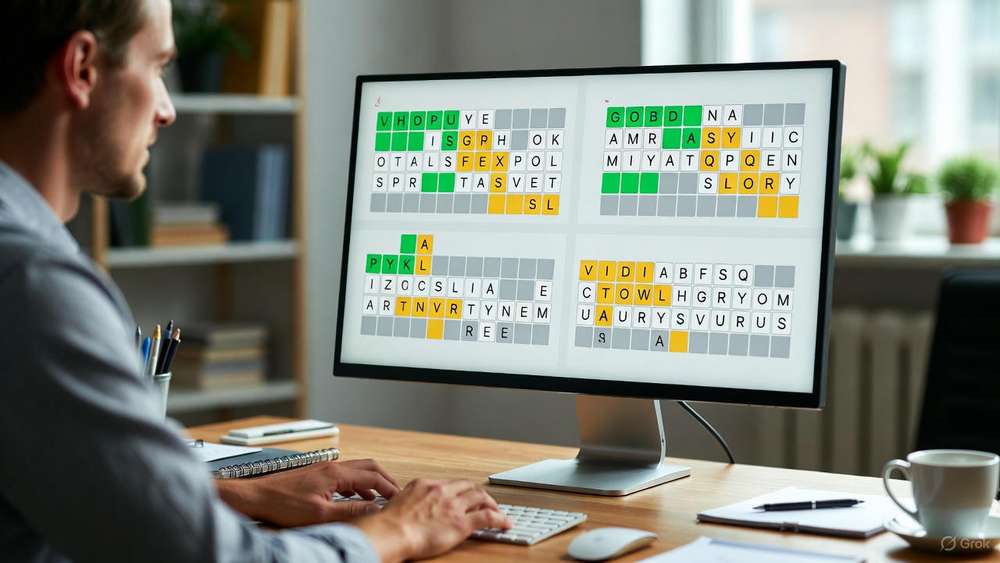
The game’s interface features four separate boards displayed side by side. As you type in a word, it populates each board, and upon submission, letters turn green if they’re correct and in the right position, yellow if correct but misplaced, or gray if not present in that word. This system mirrors familiar mechanics but amplifies the difficulty by requiring you to track multiple solutions at once.
Quordle appeals to a wide audience, from students building vocabulary to adults sharpening cognitive skills. It’s accessible online without downloads, making it perfect for quick sessions during breaks or commutes. The daily version releases a new set of words each day, while practice modes allow unlimited play for honing techniques.
One key aspect is its focus on English words, drawing from a vast dictionary to ensure fairness. Rare or obscure terms occasionally appear, adding an element of surprise. Overall, it strikes a balance between fun and frustration, rewarding persistence with that satisfying “aha” moment when all grids light up green.
The History of Quordle
Its story begins in the wake of the Wordle craze that swept the internet in late 2021. Created by software engineer Freddie Meyer, the game drew inspiration from Wordle, developed by Josh Wardle, and Dordle, a two-word variant. Meyer aimed to escalate the challenge, leading to its four-word format.
The prototype actually stemmed from an idea by engineer David Mah, who crafted an early version in a burst of creative energy. Mah’s concept, described as a “moment of evil and genius,” laid the groundwork for what would become a viral sensation. Freddie Meyer then refined it, launching the official game in 2022.
Initially, it started as a passion project with no monetization plans. Meyer shared it online, and word-of-mouth propelled its growth. Players flocked to it for the increased difficulty, often after mastering Wordle. By early 2023, its popularity caught the eye of Merriam-Webster, the renowned dictionary publisher.
In January 2023, Merriam-Webster acquired Quordle for an undisclosed sum, integrating it into its suite of word games. Meyer expressed delight at the move, noting it was the perfect home for his creation. This acquisition ensured stability and broader reach, as Merriam-Webster’s platform hosted the official version.
Post-acquisition, it continued to evolve with minor updates, such as improved accessibility features and expanded practice options. It joined other games like Blossom on the site, solidifying Merriam-Webster’s role in the digital word puzzle space. The game’s community grew, with forums and social media groups dedicated to sharing strategies and daily results.
Today, it stands as a testament to how simple ideas can scale into global phenomena. Its history reflects the rapid innovation in casual gaming, where user feedback drives improvements. From a humble prototype to a staple in puzzle libraries, it’s journey highlights the enduring appeal of word-based challenges.
How to Play Quordle
Visit the official site on Merriam-Webster or compatible apps to begin. No account is required, though some versions offer stats tracking for registered users.
Basic Rules
The core objective is to decipher four hidden five-letter words using up to nine guesses. Each guess should be a valid English word. Invalid entries won’t submit, so stick to real terms. The game provides a keyboard at the bottom to input letters, similar to other word puzzles.
Once you enter a word and hit submit, it applies to all four grids. This simultaneous feedback is what sets Quordle apart – one input yields clues for multiple puzzles. You win by solving all four before running out of attempts; otherwise, the answers reveal themselves.
Daily resets at midnight, offering a fresh challenge each day. Practice mode lets you play endlessly, ideal for beginners. Some variants allow four- to six-letter words, but the standard sticks to five.
Understanding the Feedback
Feedback comes via color changes:
- Green: Letter is correct and in the proper spot.
- Yellow: Letter is in the word but in the wrong position.
- Gray: Letter isn’t in the word at all.
Importantly, colors are specific to each grid. A letter might be green in one board and gray in another. This requires careful note-taking to avoid confusion across puzzles.
For repeated letters, the game accounts for multiples only if they appear that many times in the word. Track which letters you’ve eliminated or confirmed to refine subsequent guesses.
Best Strategies for Winning Quordle
Success hinges on efficient information gathering and logical deduction. With limited guesses, every entry counts.
Choosing Starting Words
Begin with words that cover a wide range of common letters. Popular choices include ADIEU, STARE, and AUDIO, as they test multiple vowels early. Aim for two or three starter words to maximize coverage of vowels and consonants like R, S, T, L, N.
Avoid repeating letters in initial guesses to broaden your scope. For example, pair ADIEU with STORY to hit different sets.
Managing Guesses
Use the first three guesses as “seed” words to collect data, then pivot to solving. Prioritize grids with more greens or yellows, as cracking one frees up mental space.
Employ process of elimination: List possible words based on clues and cross off impossibilities. Save words with potential doubles for later, when you have confirmation.
Common pitfalls include overfocusing on one grid or ignoring yellow letters. Treat each guess as a multi-tool, addressing needs across boards.
Advanced tips: Note letter frequencies and combine patterns from feedback. Practice regularly to build intuition.
- Cover all vowels by guess two or three.
- Test rare letters like Q, Z by mid-game.
- Use hints sparingly in supported modes.
With these approaches, your win rate can improve significantly.
Quordle Variations and Modes
Beyond the standard game, it offers modes to suit different preferences. Daily mode provides a shared puzzle for global competition, while sequence mode requires solving one grid before unlocking the next.
Some sites feature themed versions, like words from specific categories or longer lengths. Apps may include multiplayer options, where friends compete in real-time.
Practice unlimited puzzles to experiment without pressure. These variations keep the game fresh, preventing burnout.
Why Quordle is Addictive
Its allure lies in its brain-teasing balance. It sharpens vocabulary, improves pattern recognition, and offers quick dopamine hits from solves. The social aspect – sharing scores – fosters community.
Unlike passive entertainment, it engages actively, making time fly. Its accessibility ensures anyone can join, yet depth rewards experts.
FAQ
Is Quordle harder than Wordle?
Yes, due to managing four puzzles, but strategies make it manageable.
What are the best starting words?
Options like ADIEU, STARE, and RAISE are top picks for letter coverage.
Can I play it on mobile?
Absolutely, via browsers or apps like those on Google Play.
Does Quordle have hints?
Some versions offer limited hints, but core play relies on deduction.
How often does the daily update occur?
Every midnight, providing a new challenge daily.
Is there a way to cheat?
While solvers exist, they diminish the fun; stick to fair play for true satisfaction.
Conclusion
Quordle has redefined word puzzles, offering a thrilling escalation from its inspirations. From its 2022 launch to Merriam-Webster’s acquisition in 2023, it continues to captivate. By understanding rules, employing smart strategies, and practicing regularly, you’ll unlock its full potential.
Ready to Test Your Skills? Head to the official site now and start guessing – your next victory awaits! Share your scores and join the community today.
About the Author