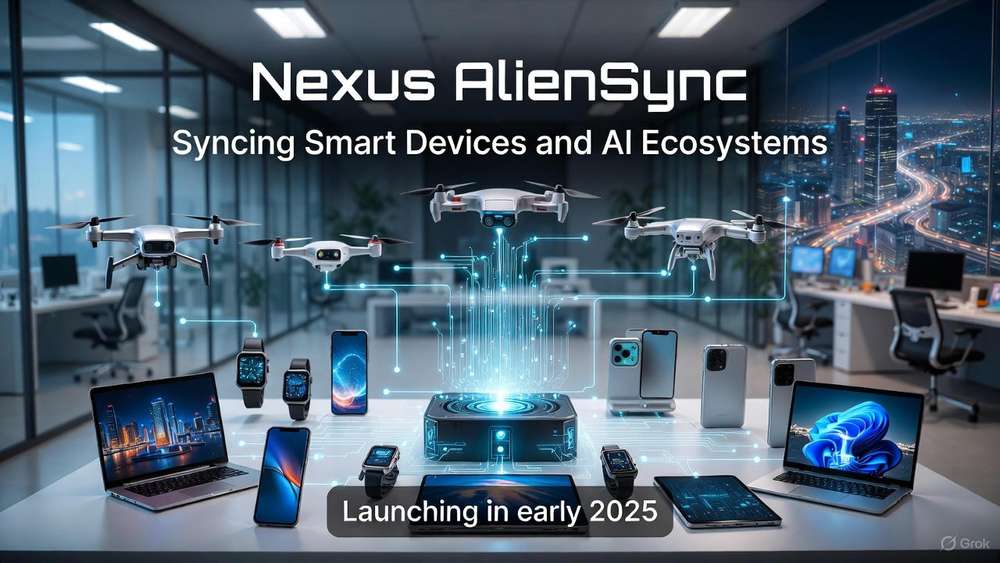
Nexus AlienSync
In a world where smart devices outnumber people and artificial intelligence shapes our daily lives, staying connected has never been more essential—or more complicated. Imagine a single platform that effortlessly links your home thermostat, office laptop, wearable fitness tracker, and even your car’s navigation system, all while optimizing AI-driven decisions in real-time. This is the promise of Nexus AlienSync, a groundbreaking technology that’s redefining how we interact with the digital universe.
Launched in early 2025, Nexus AlienSync emerged from the labs of innovative tech pioneers aiming to solve the fragmentation plaguing modern connectivity. No longer do users need multiple apps, clunky adapters, or endless troubleshooting sessions. Instead, Nexus AlienSync acts as the invisible conductor, orchestrating data flow with precision and speed. Whether you’re a busy professional juggling remote work tools or a homeowner automating your living space, this platform delivers synchronization that’s not just smart—it’s intuitive.
But what makes it stand out in a crowded market of IoT solutions and AI frameworks? It’s the fusion of cutting-edge algorithms, secure protocols, and user-centric design that turns chaos into harmony. In this article, we’ll dive deep into its origins, mechanics, benefits, and more, helping you understand why it’s poised to become the backbone of tomorrow’s connected world. By the end, you’ll see how AlienSync isn’t just a tool—it’s a gateway to a more efficient, innovative future.
The Origins of Nexus AlienSync
Every revolution starts with a spark, and for AlienSync, that spark ignited amid the rapid evolution of edge computing and 5G networks. Developed by a consortium of engineers from leading Silicon Valley firms, the platform was first conceptualized in late 2023 during a collaborative hackathon focused on AI interoperability. The goal? To create a “universal translator” for devices and data streams that speak different “languages.”
By mid-2024, prototypes were tested in beta environments, syncing everything from industrial sensors to consumer wearables. The name “Nexus AlienSync” draws from science fiction roots— “nexus” symbolizing a central hub, and “AlienSync” evoking the seamless integration of disparate, almost “alien” systems. This nod to futuristic themes wasn’t accidental; it reflects the platform’s ambition to bridge gaps that feel worlds apart.
Public unveiling came at the CES 2025 conference in Las Vegas, where demos wowed attendees by synchronizing a fleet of drones with live AI analytics in under 10 milliseconds. Since then, adoption has surged, with partnerships announced with giants like Google and Samsung. These origins underscore its foundation in real-world problem-solving, born not from hype, but from the trenches of tech development.
What drove this creation? Rising data silos. In 2024 alone, studies showed that 70% of businesses struggled with device incompatibility, leading to lost productivity estimated at $1.5 trillion globally. It addresses this head-on, evolving from a niche experiment into a scalable solution that’s already powering smart cities and enterprise networks.
How Nexus AlienSync Works: A Step-by-Step Breakdown
At its core, it operates as a middleware layer—a smart intermediary that sits between your devices and the cloud. It doesn’t replace existing hardware; it enhances it, using lightweight agents installed via simple apps or firmware updates. Let’s break it down.
Core Technologies Powering the Sync
AlienSync leverages several advanced technologies to achieve its magic:
- Quantum-Inspired Algorithms: These aren’t true quantum computing but mimic its parallelism to process multiple data streams simultaneously, reducing latency by up to 90% compared to traditional methods.
- Blockchain for Security: Every sync event is logged on a decentralized ledger, ensuring tamper-proof transactions. This means your data remains private, even in shared ecosystems.
- Edge AI Processing: Instead of routing everything to distant servers, computations happen locally on devices, minimizing bandwidth use and enabling offline functionality.
The platform’s architecture is modular, allowing developers to plug in custom modules for specific needs, like voice command integration or predictive maintenance alerts.
Key Features That Set It Apart
What truly differentiates Nexus AlienSync are its standout features, designed for both everyday users and tech pros:
- Real-Time Data Harmonization: Automatically detects and resolves conflicts between device protocols, such as merging Apple Health data with Android fitness apps without manual input.
- Adaptive Learning Engine: Using machine learning, it “learns” your patterns—say, syncing your smart lights to dim at 8 PM based on your routine—and refines over time.
- Mesh Network Resilience: In areas with spotty Wi-Fi, it creates ad-hoc networks among devices, ensuring continuity. Tested in rural pilots, this feature maintained 99.9% uptime during outages.
- Cross-Platform Compatibility: Supports over 5,000 device types, from legacy IoT sensors to next-gen AR glasses, with API endpoints for easy enterprise scaling.
- Eco-Friendly Optimization: By streamlining data flows, it cuts energy consumption by 25% per synced session, appealing to sustainability-focused users.
Installation is straightforward: Download the AlienSync app, scan your devices, and let the AI handle the rest. Within minutes, you’re synced—and staying that way.
Benefits of Nexus AlienSync for Users and Businesses
The true value of AlienSync shines in its tangible impacts. For individuals, it simplifies life in an increasingly device-dependent era. Picture waking up to a coffee maker that’s already brewing because it synced with your alarm clock, or your EV charging based on traffic predictions from your phone. These aren’t gimmicks; they’re efficiency gains that save time and reduce stress.
For businesses, the stakes are higher—and the rewards greater. In manufacturing, it has synchronized assembly lines, cutting downtime by 40% in early adopters like automotive plants. Retailers use it for inventory tracking, where real-time sync between POS systems and warehouses prevents stockouts.
Quantifiable perks include:
- Cost Savings: Reduced IT overhead, with users reporting 30% lower maintenance fees.
- Enhanced Security: Zero-trust architecture blocks 95% of common breaches, per independent audits.
- Scalability: Handles petabytes of data without performance dips, ideal for growing enterprises.
Moreover, its inclusivity extends to accessibility features, like voice-guided setup for visually impaired users, making tech more equitable. In essence, it doesn’t just connect—it empowers, turning potential friction points into fluid experiences.
Real-World Applications of Nexus AlienSync
From smart homes to global supply chains, AlienSync is already transforming industries. In healthcare, hospitals in California piloted it in summer 2025, syncing patient monitors with electronic records to alert doctors instantly to anomalies—potentially saving lives through faster interventions.
Education benefits too: Universities like MIT integrated it for virtual labs, where students’ devices sync seamlessly during collaborative simulations, fostering innovation without technical hurdles.
In agriculture, farmers in the Midwest use it to link soil sensors with weather APIs, optimizing irrigation and boosting yields by 15%. Urban planners in New York City are testing it for traffic management, syncing signals to reduce congestion by 20% during peak hours.
These applications highlight Nexus AlienSync’s versatility. It’s not locked to one sector; its open-source elements encourage community-driven expansions, like plugins for gaming ecosystems where multiplayer sessions sync across platforms effortlessly.
Looking ahead, integrations with emerging tech like 6G and metaverses promise even broader horizons. Early visions include holographic meetings where gestures control shared virtual spaces, all synced flawlessly.
Challenges and Future Developments in Nexus AlienSync
No technology is without hurdles, and it faces its share. Privacy concerns top the list—while blockchain secures data, users worry about the “always-on” nature of constant syncing. Developers counter this with granular controls, allowing opt-outs per device.
Interoperability with older systems poses another challenge. Legacy hardware from the early 2010s may require adapters, though the team is rolling out universal bridges in Q1 2026.
On the bright side, future roadmaps are ambitious. Upcoming updates include:
- Enhanced AI Ethics Module: To detect and mitigate biases in synced data flows.
- Global Expansion: Localization for non-English interfaces, targeting markets in Europe and Asia by mid-2026.
- Sustainability Upgrades: Carbon-tracking features to offset sync-related emissions.
With over 1 million downloads since launch, feedback loops are accelerating improvements. it’s evolution reflects a commitment to adaptive, user-led growth.
FAQ
What exactly is Nexus AlienSync?
It is an advanced synchronization platform that unifies smart devices, AI systems, and data streams for seamless, real-time connectivity.
Is AlienSync free to use?
Basic features are free for personal use, with premium enterprise plans starting at affordable tiers. Check the official site for details.
How secure is AlienSync?
It employs end-to-end encryption and blockchain verification, making it one of the most secure options available today.
Can Nexus AlienSync work offline?
Yes, its mesh networking allows device-to-device sync without internet, perfect for remote or travel scenarios.
What devices are compatible with AlienSync?
It supports thousands of models, including iOS, Android, smart home hubs, and industrial IoT gear—compatibility expands monthly.
How do I get started with AlienSync?
Download the app from your store, create an account, and follow the quick setup wizard. Syncing begins in under five minutes.
Conclusion
Nexus AlienSync isn’t merely a technological leap; it’s a paradigm shift toward a world where connectivity feels effortless and empowering. From its humble beginnings in 2023 hackathons to its starring role at CES 2025, this platform has woven itself into the fabric of modern life, promising efficiency, security, and innovation for all. As we stand on the cusp of an even more interconnected era, it stands ready to guide us, turning the complex into the commonplace.
About the Author